
Let`s go!
Here you'll find pretty much all the games and variations I've come up with for TPCD so far. I try to keep the list as complete as possible, but I can't guarantee the rules are one hundred percent error free. If you notice something that's not quite right or missing, I'd really appreciate your feedback.
What makes me happiest, though, is new game ideas using TPCD. If you've developed your own variation, let me know, I'm always glad to add more games to this list.
01 Playing Cards
2 bis 6 players | Age 6 +
The TPCD contains two complete decks of playing cards
Set 1, cards 1-60, with classic card symbols
Set 2, cards 61-120, with Tarot symbols
With values Ace to King
4/2 Jokers and 4/2 blank replacement cards
All classic card games can be played with it
What you Need
1 or 2 decks of cards
Important
Set 01 contains 4 blank cards (57-60), Set 02 contains 2 blank cards (119-120). These can be used as jokers, as your own house-rule special cards, or as replacements for lost cards.
Links
Mau-Mau >Game instructions
Cards must match the last card played in either suit or rank. Special cards add dynamics: a 7 forces the next player to draw 2 cards, an 8 skips their turn, and an Ace lets you freely choose the next suit. Whoever plays all their cards first and calls out 'Mau-Mau!' wins the round.
Rommee > Game instructions
Cards are laid down either as a set (3 to 4 cards of the same rank) or as a run (at least 3 consecutive ranks of the same suit). Whoever gets rid of all their hand cards first wins.
Schwarzer Peter > Game instructions
Before the game begins, one card is designated as 'Black Peter'. Players draw cards from each other face down in turn and lay down any matching pairs they find. Whoever is left holding the designated card alone at the end loses.
Skat > Game instructions
The classic German trick-taking game, played with exactly 3 players using the regular Skat rules.
02 Memory
2 to 6 players | Age 4+
The TPCD contains 60 memory pairs: 30 pairs in Set 1 (cards 1 to 60) and 30 different pairs in Set 2 (cards 61 to 120). Two consecutive cards always share the same memory symbol (cards 1+2 form pair 1, cards 3+4 pair 2, and so on), so I can freely decide how many pairs to play with.
What you Need
Any number of cards from Set 1 and/or Set 2, depending on the size you want.
Important
The choice of cards determines the difficulty: cards 1 to 10 from Set 1 give 5 pairs for children, cards 1 to 40 give 20 pairs, cards 1 to 60 give 30 pairs, and all 120 cards together give 60 pairs for the maxi game.
Setup
-
Shuffle the chosen cards well.
-
Lay all cards face down in an even grid.
Gameplay
-
A player begins and turns over any two cards.
-
If both show the same memory symbol, the pair is found. The player keeps both cards and draws again.
-
If they show different symbols, both cards are turned face down again and it's the next player's turn.
-
The game ends once all pairs have been found. Whoever has collected the most pairs wins.
Variant: Word Memory
Instead of the symbol, players pay attention to the English words. A revealed pair may only be kept if the player can explain a sensible connection between the two words. In case of doubt, the group decides.
Variant: Cross-Set Memory
All 120 cards are shuffled together. A pair consists of one Classic card and one Tarot card with the same symbol type. Knowing both sets gives an advantage.
03 Quartet
2 to 6 players | Age 6+
Quartet is played with the playing-card ranks of the TPCD. A quartet consists of all four suits (Hearts, Diamonds, Spades, Clubs) of the same rank, for example the four Nines.
What you Need
All cards with playing-card ranks. Without jokers and without blank cards.
Important
-
Setup
Shuffle all cards with playing-card ranks well and deal them out evenly among all players.
Gameplay
-
A player begins and asks another player for a specific card, for example 'Do you have the Seven of Hearts?'.
-
If the player asked has it, they must hand it over. The asking player may ask again.
-
If they don't have it, the turn ends and it's the next player's turn.
-
Whoever has all four cards of one rank lays the quartet down face up.
-
Whoever has the most quartets at the end wins.
Variant: Cross-Set Quartet
Both sets are shuffled together. A quartet now consists of Classic Hearts, Classic Diamonds, Tarot Hearts and Tarot Diamonds of the same rank. That gives more possibilities and longer games.
04 Bluff
3 to 8 players | Age 8+
Bluff is a game of deception. Players lay down cards face down and claim to be placing a specific value. Other players can challenge that claim.
What you Need
1 complete deck of cards.
Important
-
Links
-
Gameplay
-
Deal all cards evenly.
-
The first player places 1 to 3 cards face down in the middle and names a playing-card rank, for example 'Two Eights'.
-
Each following player places cards and claims to have the same or a higher rank.
-
Any player can call 'Bluff!'. Then the most recently placed cards are revealed.
-
If the claim was correct, the challenger takes all the cards laid down so far. If it was false, the caught player takes them all.
-
Whoever gets rid of all their cards first wins.
Variant: Resource Bluff
Instead of playing-card ranks, resources are named. Whoever says 'Three Wool' places three cards claiming to show Animal symbols. The challenge rule stays the same.
05 Kniffel (Yahtzee)
1 to 6 players | Age 8+ |
Every TPCD card has all the common dice types printed on it: W2, D3, D4, D6, D8, D10, D12 and D20. All values are distributed perfectly evenly across all 120 cards. Drawing a card blind simulates any dice roll.
What you Need
1 complete deck of cards. For Kniffel, also a pen and paper to note down the score.
Important
-
Kniffel with TPCD
For each roll, 5 cards are drawn blind and the D6 value is read off. Cards that aren't kept go back into the deck, which is then shuffled. Up to 3 draws are allowed per round.
-
Ones through Sixes: sum of all cards with the respective D6 value.
-
Three of a Kind: at least 3 matching D6 values, sum of all 5 cards.
-
Four of a Kind: at least 4 matching D6 values, sum of all 5 cards.
-
Full House: 3 matching plus 2 matching D6 values, 25 points.
-
Small Straight: 4 consecutive D6 values, 30 points.
-
Large Straight: 5 consecutive D6 values, 40 points.
-
Kniffel (Yahtzee): all 5 cards with the same D6 value, 50 points.
-
Chance: sum of all 5 D6 values.
Further Variants
-
Higher/Lower: reveal a card, the next player guesses whether the D6 value of the next card will be higher or lower. Whoever gets 10 correct guesses first wins.
-
D20 Adventure: every action requires beating a set threshold with the D20 value of the drawn card.
-
Resource Dice: the D10 value determines how many resources a player receives that round. The resource type is also shown on the card.
06 Coin Flip
2 to 8 players | Age 4+
Every TPCD card shows either 'Heads' or 'Tails' in the W2 field, completely replacing the classic coin flip. Since no one can see the card before it's revealed, the result is guaranteed to be random.
What you Need
1 deck of cards; a single drawn card is already enough.
Important
-
Links
-
Basic Principle
Draw a card blind from the shuffled deck and read off the W2 value. The meaning of Heads and Tails is freely agreed before each use, for example Heads equals Yes, Tails equals No, or Heads equals Team A, Tails equals Team B.
Typical Uses
-
Determining the starting player: whoever draws Heads goes first.
-
Team assignment: Heads equals Team A, Tails equals Team B.
-
Disputed decisions: in case of disagreement within the group, the Coin Flip decides.
-
Mulligan: whether a player is allowed to repeat their setup or turn is decided by the Coin Flip (see Aspect 14, Mulligan).
Coin Flip Race
Each player draws a card in turn. Heads means one step forward, Tails means one step back. Whoever reaches 10 net steps forward first wins.
Team Assignment by Coin Flip
Each player draws a card. Heads means Team A, Tails means Team B. Fast, random and fair.
Yes/No Decision
For a group decision, a neutral player draws a card: Heads means Yes, Tails means No. Optionally, the person proposing may argue their case once more on Tails and then draw a second, final time.
07 Mulligan
Extension rule for all other games
At the start of a game, it's agreed whether a Mulligan rule applies or not. The Mulligan lets a player take back or challenge their own setup or turn and start over.
What you Need
2 different Coin Flip cards per player.
Important
The meaning of Heads and Tails is freely agreed before the game, for example Heads equals Mulligan granted, Tails equals no Mulligan.
Links
-
Mulligan during Setup
If all players have to place figures, resources or other elements before the game begins, each player may request one Mulligan. To do so, the player plays their Mulligan card and their entire setup must be placed again. They then hand in their Mulligan card.
If another player then also requests a Mulligan, the same rule applies. Anyone who has already used their Mulligan can't request another one.
It could also be a house rule that you must draw one blind card from your 2 Mulligan cards, with luck deciding whether a requested Mulligan is granted.
Mulligan During the Game
In games with hand cards, a player may once per game give back their entire hand and draw a new one. The Coin Flip decides whether the Mulligan is granted.
08 Domino
2 to 8 players | Age 6+
Every TPCD card carries two domino halves. Three complete domino sets are distributed across the 120 cards: Double Six, Double Nine and Double Twelve.
What you Need
A deck of cards, sorted by the domino set you want.
Important
Double Six uses cards 1 to 28 (or alternatively 92 to 117). Double Nine uses cards 1 to 55 plus 118 to 120. Double Twelve uses cards 1 to 91.
Setup
-
Choose a set and sort out all the cards needed from the deck.
-
Shuffle the cards face down. With 2 players draw 7 cards each, with 3 to 4 players draw 5 cards each.
-
The remaining cards form the draw pile.
Gameplay
-
The player with the highest double goes first.
-
In turn, each player lays down a card whose half matches the open end of the last tile.
-
If a player can't play a tile, they draw a card from the draw pile. If it's empty, they pass.
-
Whoever plays all their hand cards first wins the round.
Scoring
The round winner receives the sum of all points on the remaining hand cards of the other players. After an agreed number of rounds, whoever has collected the most points wins.
Recommendation by Number of Players
-
2 to 3 players: Double Six (28 tiles, cards 1 to 28).
-
4 to 5 players: Double Nine (55 tiles, cards 1 to 55 and 118 to 120).
-
6 to 8 players: Double Twelve (91 tiles, cards 1 to 91).
09 Direction & Navigation Games
2 to 6 players | Age 10+
Every TPCD card shows one of eight compass directions (N, NE, E, SE, S, SW, W, NW) with its own color code, 15 cards per direction. The board is formed from the card backs, and the game pieces serve as figures.
What you Need
1 deck of cards for direction. Card backs as the board, white and black game pieces.
Important
-
Links
-
Direction Race
The board is laid out from card backs in a grid, for example 7 by 7 cards. All players start in the middle. In turn, a card is drawn, and its direction dictates the movement (1 step with a game piece). Whoever reaches the edge of the grid first wins. Anyone who would move past the edge just stays put.
Target Hunt
The board is laid out from card backs in a grid. Player A places a white game piece somewhere on the board as Player B's target, Player B places a black game piece as Player A's target. In turn, a direction card is drawn and the player's own figure is moved accordingly. Whoever reaches their target piece first wins.
Variant: Multiple Targets
Each player places several target pieces for their opponent, for example 5. Whoever collects all of their target pieces first wins. Target pieces can be placed tactically to make the opponent's route harder.
Combination Variant with Dice and Direction
A card is drawn: the direction dictates the direction of movement, the D3 value the number of steps (1 to 3). This creates more dynamics, so the board should be chosen larger, for example 10 by 10 cards.
Compass Detective
Player A thinks of a location on the laid out card grid. Player B asks Yes/No questions. Instead of answering, Player A can draw a direction card: the arrow shows the relative compass direction of the sought location from the guesser's current position. After a maximum of 10 cards, a guess must be made.
10 Chess
2 players | Age 8+
For chess we use the backs of the TPCD cards as the board, and play with the included 32 game pieces that have chess figures on them (16 white, 16 black, each marked with chess-piece symbols).
What you Need
32 game pieces with chess figures on them.
32 cards as the board.
Important
We focus on the card backs, on the square spaces of the board. See image, visual layout of the chessboard.

Setting up the chessboard
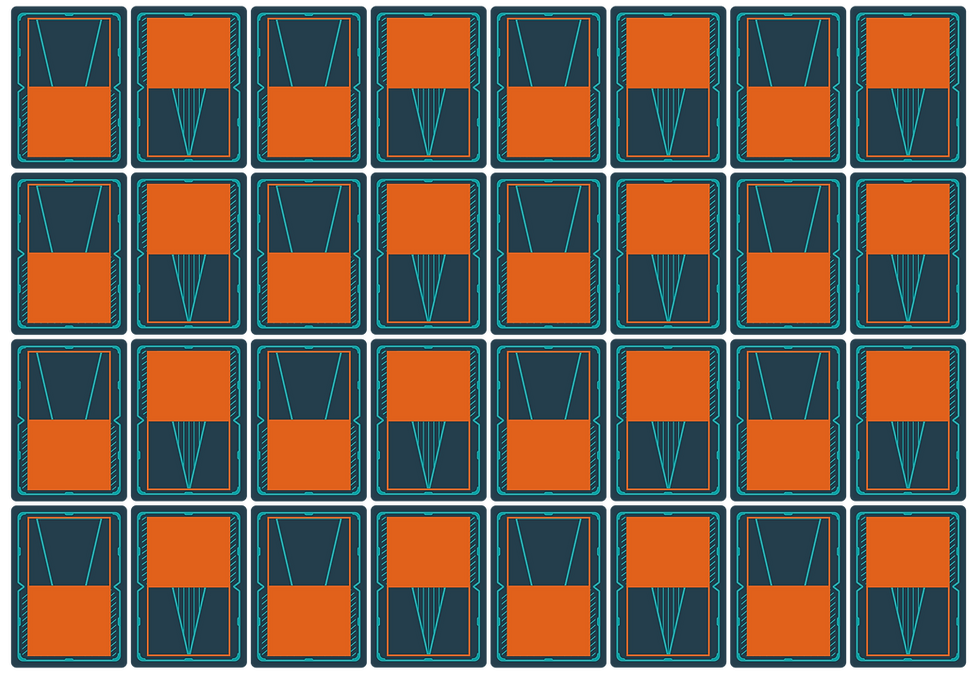
Visual representation of a chessboard
Setting Up the Board
64 cards are laid out face down as an 8 by 8 grid. The light and dark areas of the card backs create the chessboard pattern. Both card-back designs can be mixed, since both share the same color scheme.
Pieces
The 16 white and 16 black game pieces are marked with chess-piece symbols: 1 king, 1 queen, 2 rooks, 2 bishops, 2 knights and 8 pawns each. Setup follows the classic rules of chess.
Gameplay
Classic chess rules. Pieces move according to their rules. When a piece is captured, its game piece is removed from the board.
Simplified Variant
Play with pawns and rooks only (6 pawns and 2 rooks per side). The goal is to get a pawn to the opponent's back row.
Mini Chess
Lay out a 6 by 6 grid of card backs. Each player has 1 king, 1 queen, 2 rooks, 1 bishop, 1 knight and 6 pawns. Classic rules, a more compact game.
11 Checkers
2 players | Age 6+
Checkers is played with the backs of the TPCD cards as the board and the game pieces as figures. Checkers needs 12 pieces per side.
What you Need
24 game pieces, white and black.
64 cards as the board.
Important
We focus on the card backs, on the square spaces of the board. See image, visual layout of the checkers board.
Setting up the checkers board
Visual representation of a checkers board
Setting Up the Board
64 cards are laid out face down as an 8 by 8 grid. The light and dark areas create the checkers board. Play only takes place on the dark squares.
Setup
Place 12 white and 12 black game pieces each on the dark squares of the first three rows on each side.
Gameplay
-
Pieces move diagonally forward onto free squares.
-
Opposing pieces can, and must, be captured whenever there's a free square behind them.
-
Multiple captures in a single turn are allowed and mandatory.
-
When a piece reaches the opponent's back row, it becomes a king and can now move any distance diagonally in any direction.
-
Whoever has captured or blocked all of the opponent's pieces wins.
Variant: Checkers with Card Effects
When a piece is captured, the capturing player briefly reveals the card underneath. The D6 value gives a bonus: 1 to 2 no effect, 3 to 4 capture again is allowed, 5 to 6 the capturing piece is immediately crowned king.
12 Backgammon
2 players | Age 10+
Backgammon is played with the backs of the TPCD cards as the board, the game pieces as figures, and the D6 value of the cards as a dice substitute. Backgammon needs 15 pieces per side.
What you Need
24 cards as the board.
15 game pieces per side.
Important
We focus on the card backs, on the elongated triangular spaces of the board. See image, visual layout of Backgammon.

Setting up the Backgammon board

Visual representation of Backgammon
Setting Up the Board
24 cards are laid out face down in two rows of 12. 15 white and 15 black game pieces are placed according to the classic Backgammon starting setup.
Rolling the Dice
Instead of two dice, two cards are drawn blind and each D6 value is read off. The cards then go back into the deck and are shuffled.
Gameplay
Classic Backgammon rules: move pieces according to D6 values, hit and bar single opposing pieces, re enter barred pieces, bring all pieces to your home board, then bear them off. Whoever bears off all 15 pieces first wins.
13 Connect Four
2 players | Age 6+
Connect Four is played with the backs of the TPCD cards as the board and the game pieces as markers.
What you Need
42 game pieces, white and black.
21 cards as the board.
Important
We focus on the card backs, on the square spaces of the board. See image, visual layout of Connect Four.

Connect 4 Setup

Visual representation of Connect Four
Setting Up the Board
42 cards are laid out face down as a 7 by 3 grid. Player 1 uses white, Player 2 uses black game pieces. Together decide which side of the board counts as the bottom, i.e. which way the pieces fall.
Gameplay
-
Players take turns placing a game piece in a column of their choice.
-
Game pieces stack from bottom to top.
-
Whoever gets four of their own pieces in a row first (horizontal, vertical or diagonal) wins.
-
If the grid is full with no winner, the game ends in a draw.
Variant: Points Version
The game is played against the clock. Each four in a row scores the sum of the victory-point values of the cards underneath (briefly turn the backs over). Multiple rows are possible. Whoever has the most victory points from rows at the end wins.
Variant: Free Version
Each player may place their piece freely anywhere on the board. Whoever gets four of their own pieces in a row first (horizontal, vertical or diagonal) wins.
Variant: Free Version 02
Play continues until all players have placed their pieces. Then either the four-in-a-row rule or the Points Version variant applies.
14 Battleship
2 players | Age 8+
Battleship is classically played with a board drawn on paper. With TPCD, we build the board from the card backs and use the game pieces as ships.
What you Need
Card backs, depending on the size of the board.
Game pieces.
Important
We focus on the card backs, on the square spaces of the board. See image, visual layout of Connect Four.

Battleship Setup

Visual representation of Battleship

Scaled-down Battleship setup

Visual representation of Battleship (scaled down)
Setting Up the Board
I lay the cards face down into my own grid. The size of the board can be freely chosen. For example, 4 rows of 5 cards each gives a field of 5 columns and 8 rows. If I lay the cards slightly overlapping, the field shrinks to 5 rows. See images.
Placing the Ships
Together we decide how many ships each player uses. A good starting point is one ship of 5, one of 4 and one of 3 spaces. Each player places their ships with game pieces on their own field, screened off from the opponent by part of the box.
Gameplay
Player A calls out a coordinate, for example 3 across and 5 down. If they hit a ship, they get another turn. If they miss, it's Player B's turn. I always start with white game pieces as markers. When a ship is hit, I swap the piece for a black one, or remove it from the board entirely; that's up to each player to decide.
Variant: Movement Mode
Instead of attacking, a player may instead move one of their own ships one space in any direction on their turn. This makes the game more tactical. The big advantage of the card grid is that the board can be enlarged at any time; the only limit is the 120 cards in the deck.
14 Ludo
2 to 4 players | Age 5+
Ludo is played with a board made from the card backs, the TPCD game pieces as figures, and the D6 value of the drawn cards as a dice substitute.
What you Need
Card backs for the board. Game pieces as figures. 1 deck of cards as a D6 dice substitute.
Important
4 white, 4 black, 4 white chess pieces and 4 black chess pieces are used as game pieces.

Setup for Ludo
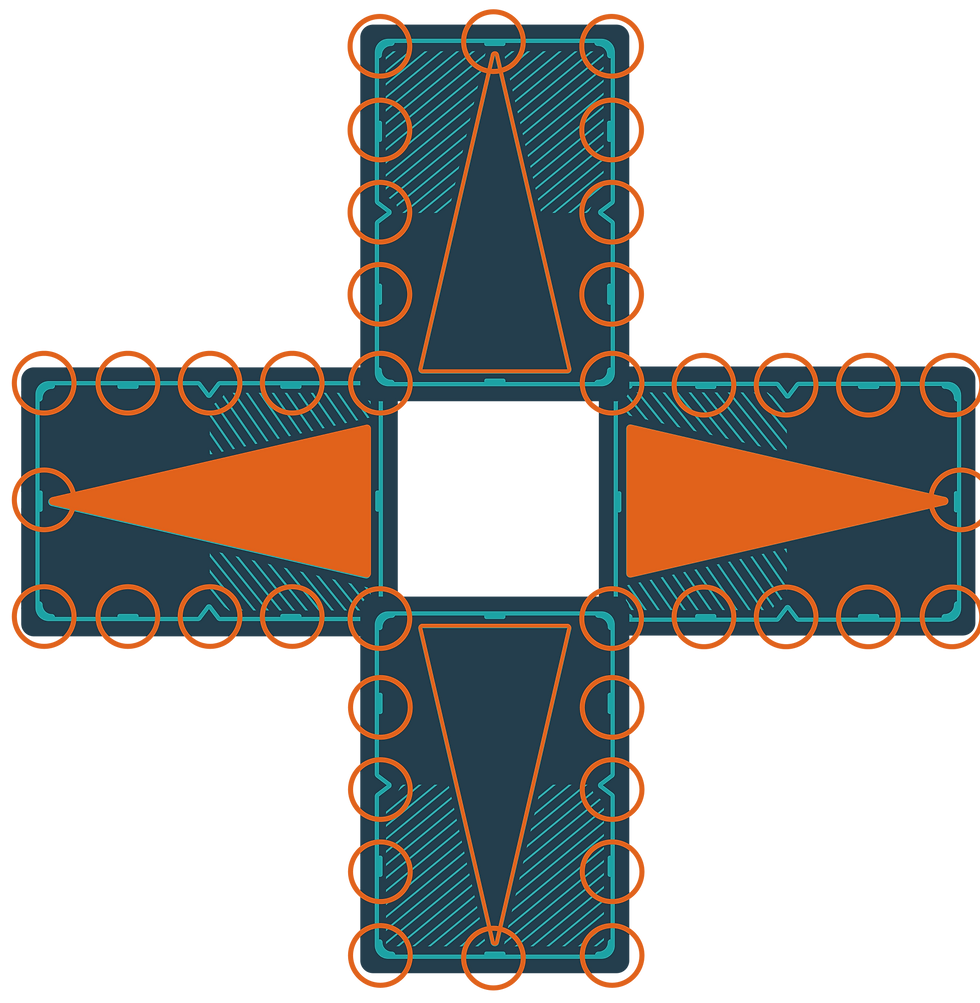
Visual Ludo
Setup
The classic board is built from the card backs. It's important to focus on the edge markers here, as they represent the step spaces for the figures. Each player uses 4 pieces of their color as figures. The D6 value of the drawn card determines the move distance.
Gameplay
Classic rules: a D6 value of 6 brings a figure out of the home base onto the start space and grants another turn. Figures move clockwise. If a figure lands on an opponent's space, that piece is sent back to its home base. Whoever gets all four figures home first wins.
Tip
For faster games, use only 2 figures per player.
16 TicTacToe
2 players | Age 5+
Tic Tac Toe is played with the backs of 9 TPCD cards as the board and the game pieces as markers.

Tic-Tac-Toe Setup

Visual representation of Tic-Tac-Toe
Setting Up the Board
Lay out 9 cards face down as a 3 by 3 grid. Player 1 uses white, Player 2 uses black game pieces.
Gameplay
-
Take turns placing a game piece on a free card space.
-
Whoever gets three of their own pieces in a row first wins.
-
If the grid is full with no winner, a new game begins.
Variant: Points TTT
Play continues until all 9 spaces are filled. Whoever completes a row of three briefly turns over the cards underneath and adds up the victory-point values. Multiple rows are possible. Whoever has collected the most victory points from rows wins.
Variant: Word TTT
Whoever completes a row must tell a sentence that connects the English words on all three cards in that row. If they can't manage it within 10 seconds, the row doesn't count.
Variant: Big TTT
The board is expanded to 5 by 5 (25 cards). The goal is a row of five. The game takes longer and requires more strategy.
17 Categories
2 to 10 players | Age 8+
The letter on every TPCD card determines the starting letter for the round. Instead of counting through the alphabet, a card is drawn blind.
What you Need
1 deck of cards.
Pen and paper for every player.
Important
-
Links
-
Setup
-
Agree on categories, for example City, Country, River, Animal, Plant, Profession, Movie Title, and write them down side by side on a sheet of paper.
-
Every player prepares a pen and paper.
-
Shuffle the deck and place it as a draw pile in the middle.
Gameplay
-
A card is drawn blind and the letter is read out loud.
-
All players simultaneously write a word starting with that letter for each category.
-
Whoever fills in all categories first calls Stop, and everyone puts their pens down.
-
Scoring: 10 points for a unique answer, 5 points for an answer that others also have, 0 points for blank or invalid answers.
-
After an agreed number of rounds, whoever has the most points wins.
Variant: English Words as a Category
The two English words on the drawn card are used as an extra category. All players must name a general term or association for each of the two words that starts with the drawn letter.
Variant: 2 Letters
Each card has 2 letters. Words must be found that contain both letters.
18 Activity
4 to 12 players | Age 10+
Every TPCD card shows an activity icon: Drawing, Acting or Describing. It also carries 4 English words from the categories Emotion, Verb, Place, Animal. The drawn card determines both the type of action and the word to explain.
What you Need
1 deck of cards.
Pen and paper for Drawing rounds. A stopwatch, a phone works too.
Important
-
Links
-
Setup
-
Split players into two or more teams.
-
Set the timer to 60 seconds.
-
Have pens and paper ready for Drawing rounds.
Gameplay
-
The active player draws a card face down and looks at it.
-
They decide, or the group decides, which of the 4 English words is to be explained.
-
Depending on the activity icon, they explain the word: Drawing means sketching it (no numbers, letters or speech bubbles), Acting means silently acting it out, Describing means describing it without using the word itself.
-
Their own team has 60 seconds. A correct guess is worth 1 point, otherwise none.
-
The game ends after an agreed number of rounds. The team with the most points wins.
19 Letter & Word Games
2 to 8 players | Age 8+
Every TPCD card carries two letters and 4 English words. That makes a wide range of letter and word games possible.
What you Need
1 deck of cards.
Optional pen and paper for notes
Important
-
Links
-
Word Poker
Each player gets 7 cards. From the letters on their hand cards, they form the longest possible English or German word. Whoever can lay down the longest valid word wins the round (1 point). After 5 rounds, whoever has the most points wins.
Word Chain
Cards are revealed one after another from the pile. Each player must name a word that ends with the letter of the previous card and begins with the letter of the new card. Whoever takes longer than 5 seconds or can't name a valid word is out.
Association Chain
Cards are revealed. The first English word is read out. The next player must name the second word on the same card and explain what connects the two. Then the next card is revealed and the second word of the previous card is linked to the first word of the new card.
20 Rock Paper Scissors
2 to 6 players | Age 5+
Every TPCD card shows one of three symbols, Scissors, Rock or Paper, 40 cards per type. Instead of hand gestures, players use cards, which makes tactical prediction impossible.
What you Need
1 deck of cards.
Important
-
Links
-
Basic Game (2 players)
-
Both players each receive 10 random cards as hand cards.
-
At the same time, each player places one card face down on the table and reveals it.
-
Scissors beats Paper, Rock beats Scissors, Paper beats Rock.
-
The winner takes both cards. In case of a tie, both cards go to the middle, and the next round decides those as well.
-
After 10 rounds, whoever has collected more cards wins.
Tournament (up to 6 players)
All players simultaneously place a card face down and then reveal it. The least frequently played symbol beats the more frequently played one. In case of a tie, no point is awarded. Whoever has the most points after 10 rounds wins.
As a Helper Mechanic
In any other TPCD game, Rock Paper Scissors can be used as a quick tiebreaker method: every player involved draws a card, and the symbol decides.
21 Roleplay and Storytelling
2 to 10 players | Age 12+
The 480 English words on the TPCD cards serve as narrative prompts. Each drawn card provides one or two concepts that must be woven into a story or roleplay.
What you Need
1 deck of cards.
Optional pen and paper for character sheets.
Important
-
Links
-
Building a Story
-
Each player draws a card and forms a sentence that includes at least one of the two English words, which may be translated into German.
-
The next player draws a card and continues the story.
-
The game ends after an agreed number of cards or once the group has found a good punchline.
Character Creation
Each player draws 3 cards. A pre agreed number of the words describe traits, backstory and goal of their character. From this, a character is developed to use in a free roleplay session.
Oracle
A question is asked. A card is drawn blind. A pre agreed number or type of the words serve as a symbolic answer, which the group interprets together. The direction on the card indicates which way the situation might develop.
Impro Theatre
Two players act out a scene. Anyone else can reveal a card at any time. The words on it must be worked into the dialogue immediately. Whoever falters or forgets a word is out.
22 Number & Letter Bingo
3 to 20 players | Age 5+
Every TPCD card has both a card number (1 to 120) and two letters. That makes a classic calling game possible, where players mark numbers or letters on a grid they create themselves.
What you Need
1 deck of cards.
Pen and paper for the grid (5x5) for every player.
Important
-
Links
-
Number Variant
-
Each player draws a 5x5 grid and enters numbers from 1 to 120 of their choosing, without repeats.
-
One player draws cards blind from the shuffled deck as the caller and calls out the card number.
-
Players who have that number in their grid mark it.
-
Whoever marks a complete row (horizontal, vertical or diagonal) wins the round.
Letter Variant
Letters are entered into the grid instead of numbers. The caller calls out the letter of the drawn card. Ideal for learning the alphabet.
In one variant, whoever marks a letter must also name a word that begins with that letter.
23 Collecting & Bidding Games
2 to 5 players | Age 12+
Every TPCD card shows one of six resources: Wool (Animal), Clay (Bricks), Stone, Gold, Wood (Trees) or Grain, 20 cards per type.
What you Need
1 deck of cards.
Optional pen and paper to note down the resources.
Important
This game variant is still being tested.
Links
-
Resource Trading (Basic Game)
-
For example, 5 resource cards are laid out face up on the table.
-
Each player draws 5 cards as starting resources.
-
The current player may always discard a card from their hand and draw a new one, or trade with another player.
-
The goal is to be the first to collect an agreed target combination.
-
Whoever reaches the target combination first wins.
Production Chain
Resources must be refined before they can be used: 2 Grain make 1 Bread, 1 Wood and 1 Stone make 1 House (5 victory points), 2 Wool and 1 Gold make 1 Trade Good (10 victory points). Whoever first has Houses and Trade Goods worth 30 victory points combined wins.
Market Auction
10 cards are laid out face up in the middle. Players bid with victory-point values from their hand to buy these cards. Whoever bids highest takes the card and notes the resource. After the auction, everyone counts their resources: whoever has the most complete collection (most different resource types) receives 20 bonus victory points. Whoever has the most total points at the end wins.
Variant: Dice Harvest
The D6 value of the drawn card determines how many units of the pictured resource a player receives that round. The D10 value can be used as a market price at which resources can be sold to the bank.
24 Victory Point Games
2 to 6 players | Age 10+
Every TPCD card carries a victory-point value. The values vary and open up various tactical collecting and bidding games.
What you Need
1 deck of cards.
Important
-
Links
-
Classic Victory Point Collecting
-
Shuffle the deck
-
Each player gets 3 to 5 cards
-
Place the remaining cards in the middle
-
In turn, each player may draw a card or pass.
-
Whoever takes a card must discard a card from their hand.
-
The next player may then take from the pile or take the last discarded card
-
After an agreed number of rounds, whoever has the most victory points on their hand cards wins
Victory Point Auction
A card is revealed each round. Players bid victory points from their hand for that card. At the end: victory points won minus victory points bid equals net score. Whoever has the highest net score wins.
Resource/Victory Point Combination
Played like the Victory Point Auction, but each resource type gives bonus points: 3 matching resources on hand cards give plus 10 victory points, a complete set of all 6 resources gives plus 30 victory points.
Variant: Minus
The lowest hand wins.
25 Flip it!
2 to 6 players | Age 10+
Flip it! is a push your luck card game for TPCD. Taking turns, players draw cards and try to collect as many different values as possible without pushing their luck too far. Anyone greedy enough to draw a value they already have loses the points for the current round.
What you Need
One complete TPCD card set (values Ace through 10).
and paper to track scores.
Important
-
Links
-
Setup
-
Before the first round, remove all face cards (Jack, Queen, King) from the deck so only the values Ace through 10 remain in play. Aces count as 1 point.
-
Shuffle the remaining cards and place them face down in the middle of the table as the draw pile.
-
One player is chosen as the dealer. This role passes clockwise after each round.
How to play
-
The dealer draws one card for each player in turn and places it face up in front of them.
-
Each player decides, in turn order, whether to draw again or hold.
-
If a player draws a value they already have face up in front of them, they've busted.
-
A blank card can be used once per round instead of busting, then it's discarded.
-
If a player collects 7 different values, the round ends immediately for everyone. That player also receives a bonus of 10 points.
-
Anyone who holds adds up the values of their face up cards to their score.
-
The game ends as soon as a player reaches 100 points. Whoever has the most points at that point wins.
Difficulty levels
Shorter games: lower the target score to 75 points.
Uncompromising variant: remove Jokers and blank cards from the deck before playing.
Longer games: raise the target score to 150 points.
Flip the W2 coin. If it shows heads, the duplicate card is discarded and the round continues normally. If it shows tails, the player loses all points for the round and is out for the rest of the round.
26 BINGO
2 to 6 players | Age 10+
Bingo brings the classic game to TPCD. Instead of balls drawn from a lottery drum, TPCD cards are used.
What you Need
One complete TPCD card set (120 cards) as the draw pile.
Paper and pens.
Important
-
Links
-
Setup
-
Each player writes down a previously agreed number of numbers from 01 to 120 on their sheet of paper.
-
One player is chosen as the caller and shuffles the cards into a face down draw pile.
How to play
-
The caller draws the top card from the pile and calls out the number in the top left corner, below the card suit symbol.
-
Each player checks their sheet. If the called number is on it, they mark it.
-
Once all players have checked, the caller draws the next card.
-
As soon as a player has marked all their numbers, they call out Bingo.
-
The caller checks the sheet. If everything is correct, that player wins the round.
27 OQUO
2 to 6 players | Age 10+
OQUO is my first self-developed game. Launched on Kickstarter in 2025. TPCD contains everything needed to play Oquo :D
What you Need
20 card backs for the board.
4 white and 4 black game pieces.
Important
-
OQUO Assembly
OQUO Visual Representation

OQUO game pieces
Setup
-
Using the card backs, lay out a board as shown in the picture.
-
Place the 4/4 pieces on the starting positions
Gameplay
-
The active player moves one of their pieces horizontally, vertically or diagonally.
-
Always just one space at a time.
-
Then it's the other player's turn.
-
Pieces may not be jumped over.
-
Pieces are not “captured”.
-
The goal is to form a square with your 4 pieces.
Difficulty Levels
Squares are also allowed standing on their “tip”.
Make the board bigger.
Pieces may be jumped over.
Link Liste
Attached are various links to further instructions for ways to play with THE POLY CARD DECK.
Standard Deck of Cards Games 01
Standard Deck of Cards Games 02
Card games using a standard deck
Card games with numbered cards
More games to discover on BoardGameGeek